Sharp Museum
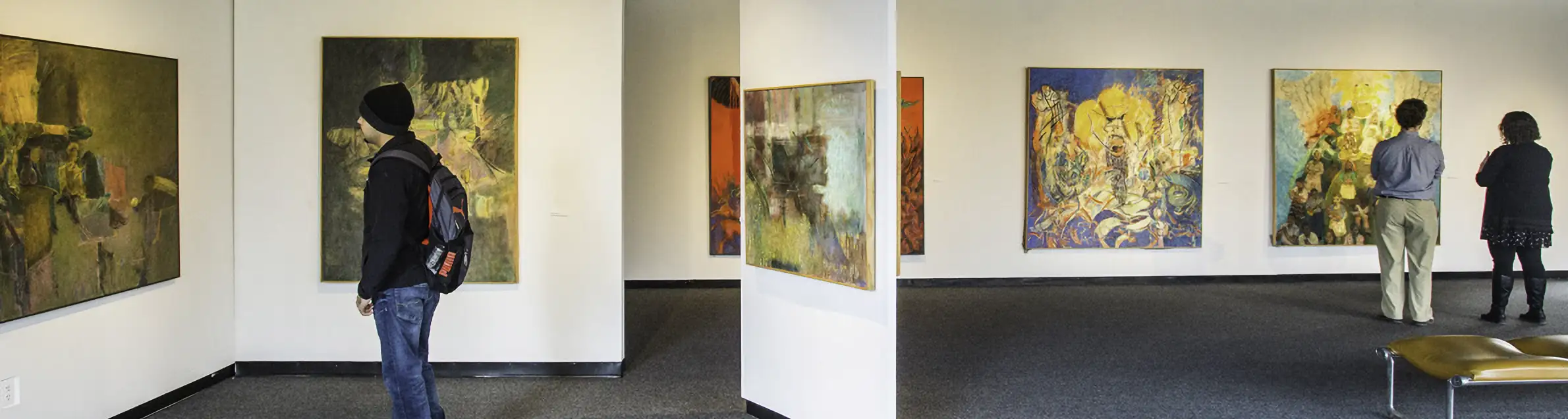
About Our Museum
First opened as a natural history museum in 1874, the Sharp Museum at Southern Illinois University Carbondale has evolved into a teaching museum that represents the humanities, the sciences and the arts. While our focus is on southern Illinois, our humanities collection includes ethnographic materials that allow us to share the world with a diverse campus and a region that is isolated from urban centers. With roughly 70,000 objects in our care, the Sharp Museum captures and illuminates the human story, opening a window on who we are and where we came from.
MUSEUM HOURS
Tuesday - Friday: Noon - 4pm
Saturday: 1pm - 4pm
Sunday & Monday: Closed
***Closed Saturday 4/11/26 due to staffing
Free and open to all.
The Sharp Museum is closed to the public during all SIU breaks and holidays.
Public metered parking available across from the Student Center and beside Woody Hall.
Mailing List
Join our mailing list today and be kept up to date on events, exhibitions, call for entries, and much more.
Exhibits
South Hall
Rosanna Sharp Gallery
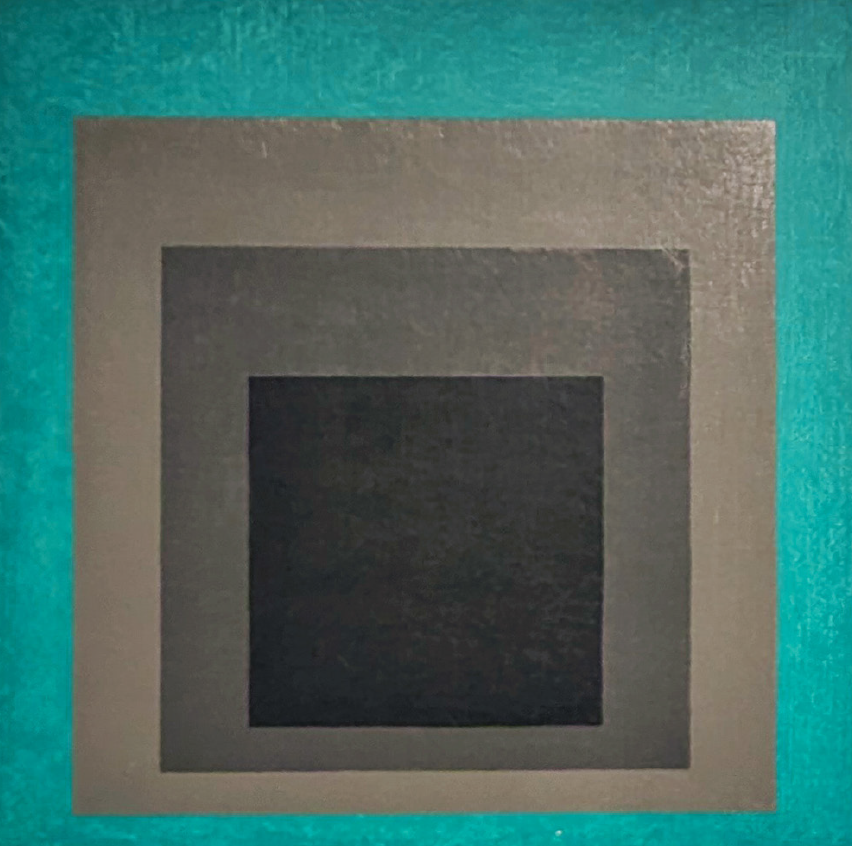
Selections from Sharp Museum Collection
Ongoing
This spring, we spotlight works by well-known artists like Josef Albers, Salvador Dali, Richard Hunt, Stephen Pace, Gabor Peterdi, Andy Warhol, and others from our collection.
Lutes Gallery
European Painting, Sculpture, and Decorative Arts
Ongoing
This exhibition highlights paintings, sculptures, tapestries, and furniture from Renaissance Europe selected from the collection of Carl W. Lutes.
Saluki Gallery
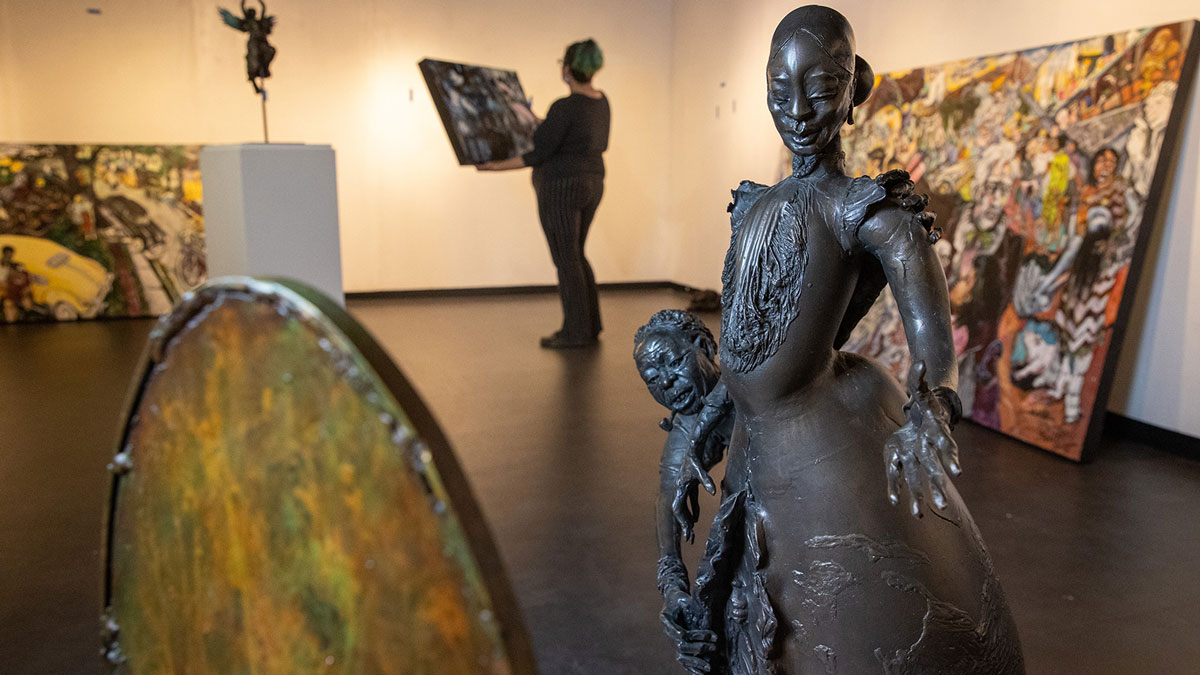
Preston Jackson | Here We Are
December 5, 2025 - June 26, 2026
Here We Are is a celebration of Preston Jackson’s recent works, both in bronze and painting. These fantastical images portray intricate narratives rooted in history. His series "Fresh from Julieanne´s Garden", reveals the lives and personalities of his ancestors and the stories of all of our forbearers who lived in the Southern United States in the 19th and early 20th century. This work reflects an admiration for the resiliency of each individual. Jackson was awarded a Regional Emmy for hosting "Legacy in Bronze", a television show featuring his Julieanne´s Garden sculptures.
Preston Jackson (b. 1944, Decatur, IL) is a visionary artist whose work spans multiple mediums and themes, from abstract expressions of emotional landscapes to complex representations of social narratives. Mr. Jackson is a professor emeritus of sculpture at the School of the Art Institute in Chicago. In 1967, Jackson enrolled in Southern Illinois University, where he earned his Bachelor of Arts degree in 1969 while playing jazz guitar with various groups from the area including Big Twist and the Mellow Fellows. He obtained his Master of Fine Arts degree from the University of Illinois in 1972. With a career that has flourished over decades, Jackson's art continues to engage and provoke audiences worldwide. His dedication to exploring the human condition, combined with his exceptional skill and innovative techniques, makes his work not only visually stunning but also deeply meaningful.
As an artist, Jackson specializes in bronze and steel sculpture as well as painting. Jackson has also created two-dimensional pieces and large monuments. His public artworks include a cast bronze relief about native American history in Peoria, a stainless steel piece about African American musicians from Champaign, Illinois; the 14 foot cast bronze Freedom Suits Memorial in St. Louis; the bronze wall façades for the Cahokia Mounds Museum; a cast bronze sculpture of Irv Kupcinet for the City of Chicago; a larger than life size sculpture of comedian Richard Pryor and a Korean War soldier in Peoria; a life size figure of Miles Davis in Alton, Illinois; life size figures of Bass Reeves, Martin Luther King, Norman Borlaug, and George Washington Carver in Decatur; monumental stainless steel and bronze sculptures for McCormick Place West in Chicago, Purdue University, Urbana Park District, Chicago Transit Authority, and Peoria Civic Center; a cast bronze monument memorializing the 1908 Springfield, Illinois race riot; a cast bronze and granite monument for Decatur Illinois; a Martin Luther King memorial bust for Danville, Illinois; a bronze bust of Fred Hampton in Maywood, Illinois; a life size bronze of Jean Baptiste Point du Sable in Peoria; a life size bronze figure of Marie Wilkinson seated on a stainless steel bench in Aurora, Illinois; a bust of Dr. Georgianna Simpson for University of Chicago; and a bust of surgeon Dr. Daniel Hale Williams for Northwestern University.
West Gallery

WORDS UNSPOKEN | LEN DAVIS & NATE POWELL
FEBRUARY 20 - APRIL 25, 2026
"Len Davis often uses comic book elements in his assemblage work. His series,1000 Words, is displayed here alongside a selection of original illustration pages by Nate Powell from various comic books he has worked on, including the famous March series. I find myself drawing similarities in the way both artists create identity. The text in Powell's work is active, whereas Davis's work uses text in a more passive way. Yet both draw us to a sense of knowing the subject without speaking a single one of the words contained within.
In Davis's 1000 Words series, he explores the literal and figurative implications of the phrase "a picture is worth a thousand words." This series in full contains one hundred 5 x 8 in. portrait collages. Davis portrays a variety of people from all walks of life, enhancing and humanizing them with the collaged elements, and all the portraits are drawn over various texts.
Powell's work often focuses on humanity, with the March series chronicling the civil rights movement through the perspective of Congressman John Lewis. One of his more recent books, Lies My Teacher Told Me, is a graphic adaptation of James W. Loewen's novel, scrutinizing American History books for inaccuracies and omissions. Other themes in Powell's work in this exhibition include punk bands, parenthood, and protests.
I read somewhere once describing reading as looking at dead tree bark and hallucinating. The mechanics behind language and the language of art never fail to fascinate me. Artists create something from what was once nothing, almost like alchemy, transmuting images from their precious art supplies. As I take in this exhibition, I ponder the importance of art and comic books in the evolution of literacy. Cave paintings predate spoken or written language. In the same sense, the unspoken word, depicted by images and hieroglyphs, was pivotal in creating language and sharing ideas. In summation, Words Unspoken is meant to prompt the viewer to think critically about humanity and the power of language."
~ T Lance, Curator of Exhibitions
Hall of Art
Oak Street Art Collective | Member Series
IN HONOR OF THE 10TH ANNIVERSARY OF MURPHYSBORO'S OAK STREET ART FAIR
Oak Street Art is a collective of eight women artists working in different media. Their mission is to nurture connections between art and their community through advocacy, education, and practice.
The collective began after two artist friends, Sue Gindlesparger and Rachel Ensor, discussed creating an art event on Oak Street’s historic brick road. Over the course of a year and the addition of several member artists, the conversation evolved from dreaming to planning to reality.
Oak Street Art Fair is a juried event open to artists making original work. The first Oak Street Art Fair took place on Oak Street’s historic brick road in Murphysboro in April 2016. The one-day fair featured a dozen exhibiting artists, live music, art demonstrations, and food from Pat’s Barbecue. The event attracted numerous visitors and included a ribbon-cutting ceremony with Murphysboro’s Mayor, Will Stephens. Although much has changed over the years, the Art Fair remains a yearly staple of Murphysboro. It continues to shine a light on what people now call the General John A. Logan Historic Arts Neighborhood.
Current members, in alphabetical order:
• Luca Cruzat (co-founder; printmaking)
• Stephanie Dillard (stained glass)
• Sue Gindlesparger (co-founder; metals, jewelry)
• Meagan Majors ( 2025, painting)
• Darby Ortolano (co-founder; ceramics)
• Nicki Rathert (2025, textile)
• Cathy Schmidt (leather)
• Madeline Steimle (fused glass, illustrations) (2022)
In addition to hosting the annual art fair, Oak Street Art members, mostly SIUC alumnae, are deeply engaged in their community by encouraging children to create their own art and offering local artists opportunities to thrive at pop-up sales and gallery shows. Mark your calendar and experience the art, creativity, and community at the 10th anniversary Oak Street Art Fair in April 2026. Be part of the celebration!
Contact them at oakstreetart1@gmail.com
You can also Like/follow their Facebook page (@oakstreetart) or Instagram @oakstreetart1. Also follow hashtags #oakstreetartgroup, #oakstreetartfair, and #oakstreetart.
Oak Street Art headquarters: 401 S. 16th St., Murphysboro, IL 62966
Study Gallery
Comming soon: Fuller Futures | Art and Artifacts
April 21 - August 28, 2026
Dr. Cho-Yee To International Gallery

Ways to Worship
This exhibition takes an anthropological look at four aspects of worship among cultures across the world. These aspects include Personal Practices such as prayer, meditation, contemplation,
scripture reading and recitation, chanting, mantras, and blessings; Expressive and Artistic Forms such as Songs and hymns, instrumental music, dance and movement, and visual arts; Rituals including offerings, sacrifices, fasting, feasting, pilgrimage, rites of passage, and divination; and Sacred Spaces. This exhibit is in no way an all encompassing exhaustive study of religion and religious traditions. This exhibit highlights only a selection of items in the Museum's archives related to religion and religious practices around the world.
Notice on Native American Collections
This exhibition does not include Native American artifacts. The Museum has placed a moratorium on displaying these objects while we undertake a comprehensive review of our collections to ensure full compliance with the Native American Graves Protection and Repatriation Act (NAGPRA). We are actively consulting with Native Nations and tribal representatives to safeguard culturally sensitive and protected materials. This process reflects our commitment to ethical stewardship, respect for Indigenous communities, and adherence to federal law. By pausing the display of Native American artifacts during this period, the Museum affirms its responsibility to protect sacred and sensitive objects and to collaborate with Native partners in shaping future exhibitions.
Exhibits
North Hall
Atrium Gallery

Beth Lo | A Chinese Immigration Story in Porcelain
January 31 - May 9, 2026
"This exhibition showcases original illustrations on porcelain for two children's books authored by Ginnie Lo and illustrated by Beth Lo. Beth Lo's illustrations are heartfelt and inspired by her and her sister's childhood memories. This exhibition is a raw outpouring of experience from the view of Chinese immigrant families. Food traditionally brings people together, and the Auntie Yang's Great Soybean Picnic plates show just how true that can be. Our sense of taste and smell hold strong memories. I can imagine anyone who attended one of Auntie Yang's picnics may recall those moments fondly and clearly anytime they slurp the salty juice that comes with eating soybeans. The story is rich with authentic instances that enhance one's view of the plate illustrations. I can almost smell and taste the soybeans and pork dumplings as I gaze upon the simple spot illustrations that supplement the main illustrations. It brings me back to a time from my own youth, when my family and our connected families would gather each summer for a potluck. There would be games, fishing, sports, contests, and prizes, much like the great soybean picnics. To be a minority, it must have been comforting to find other immigrant families to connect with over a simple dish of boiled soybeans. I often wish the world could rewind to simpler days filled with peace, fun, and food. For now, I will take refuge in these porcelain plates." ~T Lance, Curator of exhibits
"My artistic work in ceramic vessels, sculpture and drawing revolves primarily around issues of family and my Asian-American background. Cultural marginality and blending, tradition and Westernization, language and translation are key elements in my work. Since the birth of my son in 1987, I have been drawing inspiration from major events in my family’s history, the day-to-day challenges of parenting, and my own childhood memories of being raised in a minority culture in the United States.
My parents immigrated to the United States from China during WWII and my older sister and I grew up in Indiana as “ABCs”, American Born Chinese. We feel that the minority experience is largely responsible for the special closeness of our family and our Asian American friends. This is the sensibility that we wanted to share in our children’s books, Mahjong All Day Long (Walker 2005) and Auntie Yang’s Great Soybean Picnic, (Lee and Low 2012). We each took sabbaticals from our respective university teaching jobs to create these two books. Ginnie wrote the words and I illustrated the stories with underglazes on porcelain plates." ~ Beth Lo
Born in Lafayette, Indiana to parents of Chinese nationality, ceramicist Beth Lo makes work about family, culture and language. Her Good Children vessels and sculptures have been exhibited internationally, and her work has been recognized by fellowships from United States Artists, the National Endowment for the Arts, the Montana Arts Council and the American Craft Museum. She is a Professor Emeritus of Art and taught Ceramics at the University of Montana from 1985-2016. Beth is also an award-winning children’s book illustrator and professional bass player for several musical ensembles.
Continuum Gallery

Bittersweet Harvest: The Bracero Program
This exhibit features a little-known chapter in American history as its fall 2012 free resource for schools, migrant education centers, museums and libraries across the country. “Bittersweet Harvest: The Bracero Program, 1942-1964,” a colorful set of six bilingual posters with images and interviews by documentary photographer Leonard Nadel, is based on the traveling exhibition by the same name, currently touring the United States.
The goal of the poster sets is to celebrate the impact and achievements of migrant farm workers by enabling people of all ages to learn more about the stories behind the Braceros. Online educational resources and downloadable poster files are available at www.sites.si.edu/bracero.
Facing labor shortages on the home front during World War II, the United States initiated a series of agreements with Mexico to recruit guest workers for American farms and railroads. The Emergency Farm Labor Program, more familiarly known as the Bracero Program, enabled approximately 2 million Mexicans to enter the United States. While the work was often grueling, the program offered participants economic opportunity. The contributions made by these laborers have had significant impact on the political, economic and social climate of both the United States and Mexico.
“Bittersweet Harvest: The Bracero Program, 1942-1964” was organized by the National Museum of American history in partnership with the SITES, and received federal support from the Latino Initiatives Pool, administered by the Smithsonian Latino Center.
SITES has been sharing the wealth of Smithsonian collections and research programs with millions of people outside Washington, D.C., for 60 years. SITES connects Americans to their shared cultural heritage through a wide range of exhibitions about art, science and history, which are shown wherever people live, work and play. For exhibition descriptions and tour schedules visit www.sites.si.edu.
The National Museum of American History collects, preserves and displays American heritage in the areas of social, political, cultural, scientific and military history. To learn more about the museum, visit www.americanhistory.si.edu. For Smithsonian information, the public may call (202) 633-1000.
The Smithsonian Latino Center is dedicated to ensuring that Latino contributions to arts, sciences and the humanities are highlighted, understood and advanced through the development and support of public programs, scholarly research, museum collections and educational opportunities at the Smithsonian Institution and its affiliated organizations across the United States.
Mitchell Gallery

For The People: The Federal Art Project and SIU
The Sharp Museum will host an opening reception Friday, February 20, for a new exhibit on the impact of the Federal Art Project (FAP) on the SIU campus and its legacy in the museum’s collections. The reception will be held in the museum from 4:30 to 7:30 and will feature a screening at 5:30 of The Murals, a documentary by Chicago filmmaker TG Jamroz about a pair of New Deal era murals in the Uptown Post Office painted by Henry Varnum Poor.
The SIU exhibit will feature nine of the mural panels that once decorated the second floor of Wheeler Library; 19 paintings by artists employed under the FAP; six carvings by West Frankfort sculptor Fred Myers, who worked for the SIU museum as part of the FAP; and five of the 21 dioramas showing life in frontier southern Illinois that were made by a team of artisans in the basement of Altgeld Hall between 1939 and 1942, also under the FAP.
The Wheeler mural panels, by German-born artist Karl Kelpe, feature scenes from southern Illinois history such as the 1825 visit of General Lafayette to the home of Pierre Menard. Removed from Wheeler when the new library opened in 1956, the canvas panels have been in storage ever since, except for one panel depicting the Lincoln-Douglas debate in Jonesboro, which hangs permanently in Faner Hall outside the Sharp Museum.
The 19 paintings from the museum’s collection include a number of artists based in Chicago, such as Aaron Bohrod and Joseph Vavak, as well as local artist Maude Craig, a quilter who turned to painting in her 50s and produced bright scenes of life in and around Creal Springs. Bohrod taught at SIU as a visiting artist in 1941-42 before joining the Army War Art Unit; his sketches of the Pacific War and of Normandy after D-Day were featured in LIFE Magazine.
The exhibit includes six Fred Myers pieces, all carved in black walnut, highlighted by a sculpture of Abraham Lincoln. A former coal miner and self-taught sculptor, Myers worked for the museum from 1939 to 1942, at first carving prehistoric animals for exhibits before turning to more contemporary subjects at the encouragement of director John W. Allen.
The dioramas project employed up to 28 people under Allen’s direction, using wood, metal, beeswax and other materials to create miniature people, furniture, tools, dwellings and other objects of frontier life in scenes depicting House Raising, Maple Syrup Making and other pioneer tasks.
The Murals documentary features an in-depth look at Henry Varnum Poor, who founded an arts colony north of New York City in the 1920s. Poor was married to the writer Bessie Breuer, whose papers are incidentally held in Morris Library’s Special Collections Research Center.
Part of the New Deal Works Progress Administration, the Federal Art Project was launched to give meaningful work to artists across the nation, including here in Illinois. In return, some of the art was given to the public, either distributed to museum collections or as murals in public buildings such as post offices, where many can still be seen.
The exhibit in the Sharp Museum will be open throughout the spring semester.
As with all exhibitions, the artwork represents the viewpoints of its creators, not SIU. SIU complies with the Illinois Governmental Ethics Act and State Officials and Employees Ethics Act.
***The Sharp Museum's online collections have moved to a new home. Our digital exhibitions and recorded artist's talks can be found on the Resources page through the main navigation menu.